


I would rather be an unstoppable force than an immovable object. The belief that I will get somewhere if I just keep pushing is the only thing that wills me to take action some days. In the second quarter of this year, that manifested in an intense immersion into art, especially as I began to read at a greater rate than I have for the past several months, and I found myself at dance shows multiple nights a week.
I often find myself in a bit of a bind: there is so much I want/need to see in order to learn more and have greater frames of reference, but the investment of my time in this kind of consumption decreases the amount of time I have to digest it. I can kind of gorge myself on art—buying tickets last minute is one of my favorite salves for despair or general insipidity. If I have an empty evening, it often feels like I need to go see something. You may call it FOMO. I call it artistic investment.
It adds up, somehow, I have to tell myself—and I do see small instances of this as the investment of my time grants me some return; a new reference or a new point of context. (After seeing Morgan Griffin’s homage to Robert Rauschenberg, I saw Lucinda Childs talk about her work with the late artist not even a week later.) There is always more to uncover. And so I continue.

Dance
I saw 23 dance performances in Q2 of 2026. I reviewed a bunch for Fjord Review—those are linked: Hubbard Street Dance at the Joyce, two of the Martha Graham Company’s programs at New York City Center, Johnny Loves Johann at the Joyce, the Youth America Grand Prix gala and Dance School Festival, Dance Theatre of Harlem at New York City Center, New York City Ballet’s “Icons and Innovators,” “Contemporary Choreography III,” and “Eclectic NYCB II” programs, Parsons Dance at the Joyce, ABT Studio Company at the Joyce, Aszure Barton’s one-night-only showcase at the 92Y, Graham II in the company’s new studios, Scottish Ballet’s “Mary Queen of Scots” (reviewed in this very newsletter), BalletCollective’s “Translation,” Ballet Rose’s “Made in Miami,” American Ballet Theatre’s Swan Lake (x2) and Onegin (x2), Morgan Griffin’s Homage to Robert Rauschenberg: “Training Spring Training,” and Lucinda Childs’s “Momentary Reprise” at Bard’s Fisher Center.
Here are a few of the highlights:
“Blue Soup” by Aszure Barton, performed by Hubbard Street Dance
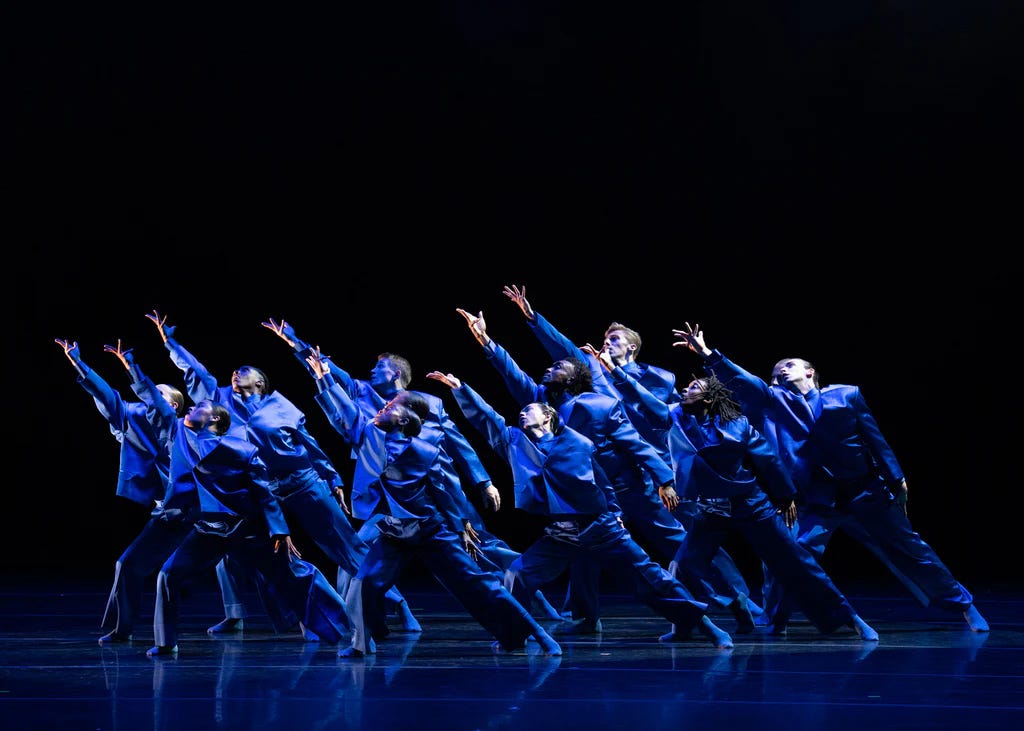
Ever since I saw Hubbard Street Dance in New York City Center’s Fall for Dance last year, I’ve been of the opinion that it might be the most underrated dance company in the U.S. “Blue Soup,” which runs about 40-ish minutes long, is the perfect vehicle for its dancers, who vary widely in style and personality, yet across the board demonstrate extraordinary athleticism and a complete commitment to character. Aszure Barton’s choreography has a distinct lexicon of tumbling limbs, squiggling torsos, and gesturally complex sequences in which a single movement operates like a one-sixteenth note within a bar of music. Important: it also has a sense of humor, and one that’s driven by surprise, rather than vaudevillian hijinks. I got to see this piece twice, in both of Hubbard Street’s programs for its two-week visit to New York. I thought about it endlessly after.
“Continuum” by Christopher Wheeldon, performed by New York City Ballet
A new addition to New York City Ballet’s repertoire, and one of the standouts for me in the spring season. Wheeldon’s choreography here has a crispness that felt very satisfying to watch—it’s almost mathematical both in the exacting formations that the dancers follow and in the occasional angular gestures they make with a hand or foot. This entirely contemporary program also included Lar Lubovitch’s “Each In Their Own Time,” Edwaard Liang’s “Distant Cries,” and Alexei Ratmansky’s “Concerto DSCH.” I left the theater feeling thoroughly refreshed (even if some of the humor in “Concerto DSCH” wore thin overtime).
“Steps in the Street” by Martha Graham, performed by the Martha Graham Company
Martha Graham’s “Steps in the Street,” one part of her larger work, Chronicle, debuted in 1936. Subtitled “Devastation – Homelessness – Exile,” the work illustrates the aftermath of war; it was also created as a reproach to fascism, as earlier that year, Graham had declined an invitation for her company to participate in the Olympic’s opening ceremony in Germany. Stark, exacting, and haunting, this work illustrates Graham’s ability to capture a deep, emotional reaction through her signature style of movement.
“Firebird” by John Taras, performed by Dance Theatre of Harlem
It was a spring full of Firebirds, but Dance Theatre of Harlem’s version by John Taras took the cake for me (though I did love seeing Cate Hurlin and Chloe Misseldine in Ratmansky’s quirky version for ABT; I missed City Ballet’s this year, but I’ve caught that one a few times in the past few years and always enjoy it). This was the strongest piece in DTH’s programming for City Center, both in terms of choreography and execution. Really, it’s a visual treat. Hoping that this is the start of the company reviving some more of its repertoire that’s been dormant!
“Available Light, Part 2” by Lucinda Childs, performed by the Lucinda Childs Company
As a whole, Lucinda Childs’s show at Bard was exceptionally programmed. I went in expecting to love the Philip Glass pieces in the show (and did) but this John Adams collaboration was a real delight—and a perfect encapsulation of Childs’s signatures of repetition, the combination of a balletic vocabulary with pedestrian modes of movement, and the cross-hatching of dancers shifting through different formations.
Books
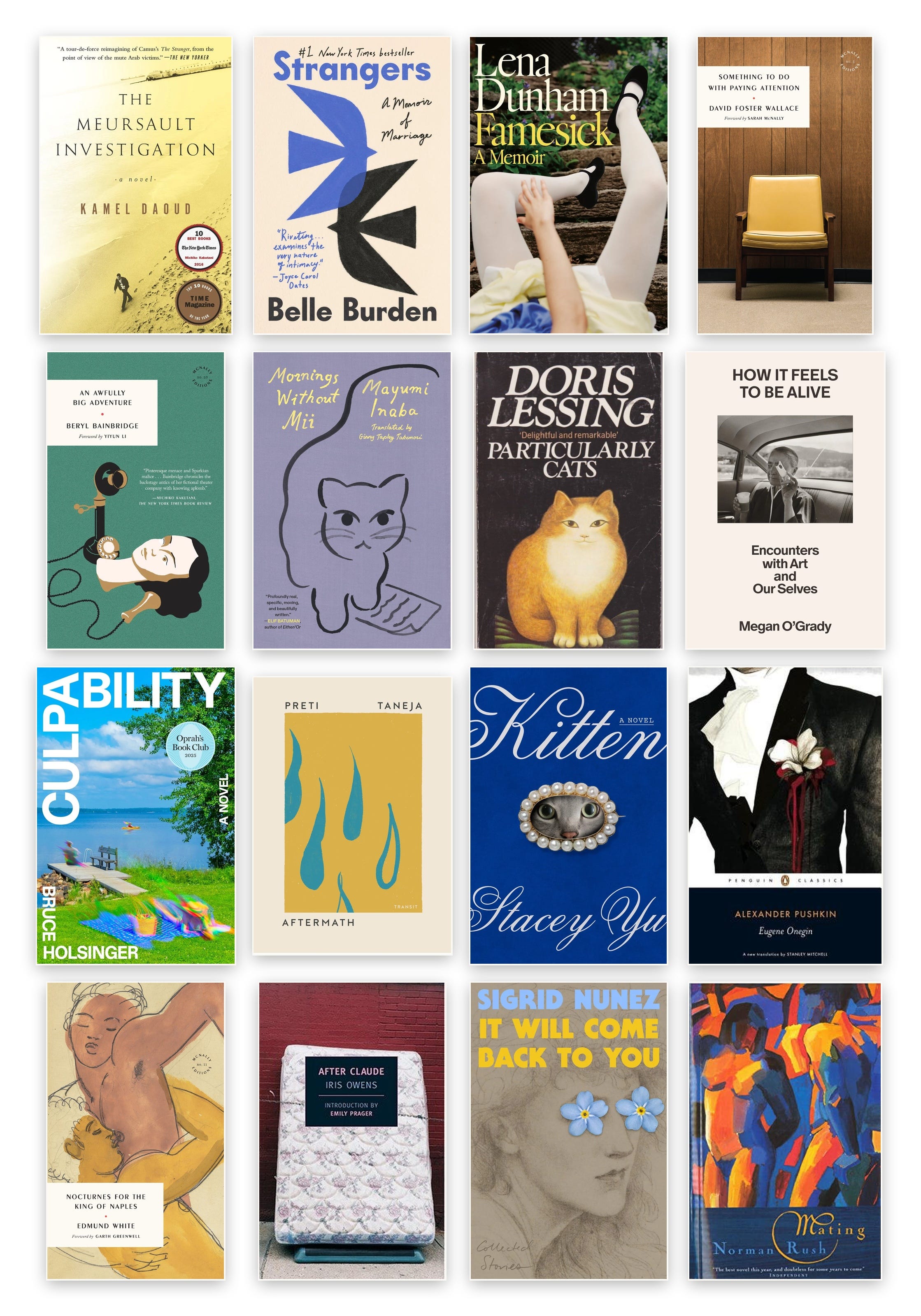
The Meursault Investigation by Kamel Daoud: A retelling of Albert Camus’s The Stranger, told from the perspective of the brother of the unnamed Arab, who Camus’ protagonist Meursault kills. Philosophical yet propulsive. Do read The Stranger first for maximum effect.
Strangers: A Memoir of Marriage by Belle Burden: Is it the best book I’ve ever read? No. Is the prose anything remarkable? Also no. But it was solidly written and I finished in about 24 hours (with several of those hours on a plane) and made me really pissed off.
Famesick by Lena Dunham: I was sat!
Something to Do With Paying Attention by David Foster Wallace: This was my April pick for the McNally Editions book club, and more men attended than have ever attended before…lol. Still: a great entry point into Foster Wallace. Funny with a few particularly striking moments that will catch you off guard.
An Awfully Big Adventure by Beryl Bainbridge: I just love a darkly comic mid-century British novel, don’t you?
Mornings Without Mii by Mayumi Inaba: Reading cat-centric books as a grief exercise is both helpful and painful.
Particularly Cats by Doris Lessing: Less emotional than the above and a bit shocking in its frankness. Propulsive, though.
How It Feels to Be Alive: Encounters With Art and Ourselves by Meghan O’Grady: The kind of memoir that makes you feel less alone, especially in its articulation of how we may find ourselves, in different parts of our lives, in artworks we may return to at future points, both the same and changed.
Culpability by Bruce Holsinger: Read for work book club. I was a hater :/
Aftermath by Preti Taneja: Poetically written, philosophically nuanced, altogether gripping.
Kitten by Stacey Yu: I want my unlikable female characters to be a bit more…interesting. (Also: extremely triggering w/r/t cat grief). Still, well-paced.
Eugene Onegin by Alexander Pushkin: The original literary fuckboy. Holds up!
Nocturnes for the King of Naples by Edmund White: Lovely prose caught in floating vignettes; a thoughtful look-back at a relationship with strong character depictions.
After Claude by Iris Owens: Funny girl in New York who is a menace to her French boyfriend—fantastic. Then something shifts.
It Will Come Back to You by Sigrid Nunez: Short stories that catch you off guard, parsing the extraordinary in mundane moments.
Mating by Norman Rush: Technically finished at the start of Q3. Added to my canon of books—alongside Middlemarch—that have changed the way I think about relationships. Surprisingly funny, kind of devastating, and constructed in a vivid landscape. A 32-year-old female protagonist who made me feel almost uncomfortably seen.
Art
I didn’t frequent very many museums in Q2, but I did see the Raphael and Musical Bodies exhibits at the Metropolitan Museum of Art, as well as the Frida Kahlo and Diego Rivera exhibit at the MoMA, which was thoughtfully produced (I love that it was designed by the set designer for the Metropolitan Opera’s Último Sueño de Frida y Diego). I also attended one of the Guggenheim’s Late Shifts, which featured a performance by cellist Clarice Jensen and a pop-up of Pawn Chess Club. They’re doing it again this Thursday.
Music
I went to Baryshnikov Arts for the first time and enjoyed pianist Clara Yang and visual artist Xuan’s audio-visual experience, featuring a number of immersive contemporary compositions.
On the classical side of the spectrum, I saw two concerts produced by Fort Greene Orchestra, which is doing really excellent work to get more people into classical music. Daniel Zinn and pianist Vladimir Rumyantsev put on a sold-out show at Carnegie Hall, featuring music inspired by the moon, which was a treat. A few weeks later, I saw Fort Greene Orchestra play Vivaldi’s “Four Seasons” on a distressingly humid day in Manhattan—in the un-airconditioned Church of St Mary the Virgin. I was impressed with the musicians, as I was impressed with the folks running the event, who passed our hand fans and bottles of water to attendees.
And, as I mentioned last week, I went to Rosalía’s Lux tour, which I loved.
Theater
Innocence was the only opera I saw in Q2, but I’m determined to make up for that in Q4, once the Met is back in full swing. This one was really stirring—one of the Met’s more interesting commissions in recent years.
Off-broadway, I saw Dad Don’t Read This, a wonderful play about teenage girlhood, which I wholeheartedly recommend. I also saw the one-woman show Furniture Boy at Soho Playhouse by Emily Weitzman, which offered some more absurdity.
On Broadway, I saw Becky Shaw, Every Brilliant Thing (featuring Daniel Radcliffe), and Proof. The latter was my favorite, with a strong performance by Ayo Edeberi. The first show took me off guard, and I spent much of it trying to figure out if I liked it or not (ultimately, I decided, I could take it or leave it). Every Brilliant Thing was a bit saccharine, but sometimes we can all use that, no? ▲