


There are four ballet performances that have nestled into my long-term memory more than others, playing on repeat despite their ephemerality. The first was in 2007, and it’s admittedly faint—more pronounced in its plotline than anything. I was attending the Rock School’s summer intensive and saw Royal Ballet’s Swan Lake in Philadelphia. Tamara Rojo, who was playing Odette, hurt her foot during act II, leading Roberta Marquez to step into the role of Odile; Rojo recovered and returned for act IV.
The second was in 2023, seeing Natalia Osipova and Reece Clarke perform Don Quixote in Covent Garden—a theater I’d read about since I was a child—on my first-ever solo trip. The third was last year: Gillian Murphy’s final performance in Swan Lake, an unfathomably perfect execution both artistically and technically, paired with an uproarious audience.
And the fourth was a little more than two weeks ago, as Skylar Brandt and Jake Roxander performed Don Quixote at the Metropolitan Opera House. I hadn’t seen Don Q since that Royal Ballet performance, and I was eager to see Roxander play Basilio. He wasn’t originally cast in the role when ABT announced its summer season—a disappointment, as I assumed the athletic part would be his ideal role.
Then ABT principal Isabella Boylston announced her pregnancy, and her mat leave triggered a number of casting changes—including a single performance of Don Quixote, in which Roxander would now be playing Basilio, partnered with the sparkling Skylar Brandt. I was more excited for this than I was for the Natalia Osipova guest performance I also bought tickets for (only for Osipova to cancel due to an injury and be replaced by the phenomenal Cate Hurlin).
This was, I suppose you could say, my Super Bowl—as I called Murphy’s final show last year. It is hard to describe to people who haven’t been to a performance of a full-length ballet—much less one that was as riotously enthusiastic as this one—what it is like to watch a show come together with the dancers operating at impossible levels of excellence. The audience roared from the first act. The show only got better from there. Takumi Miyake, an ABT soloist, was astonishing in the role of Lead Roma. Brandt nailed Kitri’s humor and risk-taking. It was hard to imagine a Basilio better than Roxander, who astonished with never-ending pirouettes and rocketing leaps. A few times, I laughed. It was too good—I couldn’t believe what I was seeing. The cheers both in-between and during numbers started to sound like the audience at Knicks game five.
During curtain calls, I realized something was about to happen when I saw a hand offstage gesture the dancers to go forward and bow one more time. Then ABT artistic director Susan Jaffe appeared next to Roxander. “Oh my god,” I turned to my friend, “it’s happening.” Tears almost immediately streamed down my face.
Roxander was promoted onstage as principal dancer that night—becoming the first in a series of three onstage promotions this Met season; SunMi Park and Jarod Curley also became principals after their respective final Swan Lake performances. Later in the season, six dancers in the corps—Zimmi Coker, Michael de la Nuez, Tyler Maloney, Joseph Markey, Andrew Robare, and Yoon Jung Seo—were promoted to soloist. I also saw Kayla Mak, a recent Juilliard grad, get a quiet promotion from apprentice to full corps member.
This season was the first time I experienced an onstage promotion IRL. I told friends it was like my favorite player winning the championship and getting MVP. This was my Knicks in five (though that was fun, too). If you’ve been reading this newsletter for a while, you know I’ve been publicly rooting for his promotion for more than a year; really, I’ve been singing his praises ever since I saw him as Mercutio in Romeo & Juliet two years ago.
Why does the success of various dancers’ careers feel so personal to me? There’s probably some transference of my own evaporated ambitions in ballet, and there’s a level of self-interest; I want to see these dancers perform principal roles. Above all, though, I think it’s the payoff of something quite simple. It feels good to see someone achieve greatness, especially when you have some inkling of what it took for them to get there.
Roxander, in my view, was a bit of an underdog. He—like the spectacular Miyake—is a shorter dancer, which makes him a less obvious choice for “leading man” roles, and more limited in his choice of partner (luckily, though, ABT has fantastic female dancers of all heights). He’s also incredibly young, just 24 years old. Still, it grew increasingly hard to watch his rise and ask, after each performance, “when is it going to happen for him?”
That feeling, I think, is familiar to a lot of us when it comes to our own ambitions. The quickest path to burnout is to pour yourself into a job in the express hopes of securing a title or raise that just doesn’t come. Of feeling like you don’t know what more you could possibly be doing—and giving up because continuing to make the effort doesn’t seem worth it. I realized, later than I wish I did, the importance of working hard for myself, rather than for some advancement that wasn’t guaranteed. You need to think about what you are getting out of it—not including any recognitions or rewards that come from the decision of a party external to you, I recently advised someone younger than me, with regard to career progression.
Roxander, in his first post-promotion interview with the New York Times, shared this idea. “I dance my best when I’m joyous,” he said. “I can dance well when I am angry and when I have something to prove, but there is no comparison to when I’m dancing out of just joy for the game.” You win doubly when you work out of love—for yourself and for the thing you feel most called to do.
Here’s what you need to know about in the world of art and culture today.
We have a touch more information about the Boston Symphony Orchestra’s firing of Adris Nelsons, thanks to a new feature in Boston magazine. It turns out that earlier New York Times reporting, which said that the BSO had begun separation talks with Nelsons back in September, was incorrect. President and CEO Chad Smith says that he wanted to extend Nelsons’s contract, but discussions devolved by December, when the board realized they were at a “critical juncture” about the vision for the orchestra’s future. (Though Nelsons said in a statement that it was never explained to him how he wasn’t aligned with that strategic vision). Smith says that Nelsons was offered residencies in the next two seasons, as well as continued touring, an honorific title, and “special projects.” Nelsons disputes this.
Smith, who joined BSO in May 2023 from the LA Philharmonic, is an interesting figure here, with a former BSO employee telling Boston he’s “one of the smartest, if not the smartest” people they ever met, though that same person, and others, describe his management style as autocratic.
The story notes that the orchestra’s financials do reflect brewing challenges—with attendance at core classical concerts dropping, leading to annual deficits inspite of its $600M endowment. Board chair Barbara Hostetter, who assumed her position in January 2021, was the one who replaced former CEO Mark Volpe with Gail Samuel—who lasted just 18 months in the role—and then with Smith.
Smith has been investing in the kind of ambitious programming the board has pushed for, but it seems that players have increasingly felt that there is no space for their own feedback. Some musicians point out that Hostetter and Smith don’t even know the names of all the members of the orchestra. This is a fascinating story—a true workplace saga that shows that, as reporter Tom McGrath puts it, “you can have the smartest ideas in the world, but you’re only a visionary leader if you can actually get people to follow you.”
Nevertheless, the orchestra’s always anticipated summer festival Tanglewood goes on. Earlier this month, Philip Glass debuted his Symphony No. 15, “Lincoln” at the festival, alongside a program that included John Williams’s music for the Spielberg film Lincoln and Aaron Copland’s “Lincoln Portrait,” with narration by Alec Baldwin. The symphony—like the Copland piece—includes parts of Lincoln’s speeches. Glass wrote in the program notes, “Lincoln’s legacy of holding the country together in a period during which it was ripping itself apart—seemed an appropriate subject to consider on this, our country’s 250th birthday,” NPR reported.
Los Angeles is getting its own outdoor classical music concert, with pianist Hunter Noack performing in Griffith Park on September 26 and 27, Los Angeles magazine reports. These outdoor performances are Noack’s whole thing; he’s known for his series “In a Landscape,” through which he’s played a Steinway grand piano in national parks and other rural landscapes. Attendees listen via headphones, so they can fully hear his playing, while taking in the scenery. He has a number of other concerts coming up in Oregon, Utah, and Washington.
You can also get your classical fix in San Francisco, thanks to Philharmonia Baroque’s free monthly Baroque & Brew concert inside the Conservatory at One Sansome. The next one is August 21 at 10 a.m.
Guess we should go to Kentucky. Mikhail Baryshnikov—along with Wendy Whelan and Clinton Luckett—is helping celebrate Louisville Ballet’s 75th anniversary with a special panel event on February 12, followed by a performance of Carmen. Tickets are $250, which compared to galas here in New York, seems astoundingly affordable.
Ballerina Farm helped throw a ballet festival. “From Root to Relevé,” an event in collaboration with Ballet West, featured screenings from the initiative Final Bow for Yellowface (which is devoted to fighting Asian stereotypes in ballet, of which there are many across the classical canon), as well as performances by Ballet West artists. Ingrid Silva, who recently retired from Dance Theatre of Harlem and is leaning into her budding choreography career, was one of four choreographers to debut new work at the festival.
A situation we are monitoring: The American ballet dancer Julian MacKay was suddenly fired from his position as a principal at the Bavarian State Ballet. “After raising concerns about what I felt was misconduct andunfair treatment in the ballet department I asked theatre manegment for this to be looked into or I would resign,” he wrote on Instagram. “Instead this morning I was fired with immediate termination while I am on sick leave.” He added in a later post that he is pursuing legal action, believing his contract to be terminated unlawfully. His comments and likes are full of supporters in and around the ballet world.
There’s a big Frida Kahlo exhibit at the Tate Modern right now; “Frida: The Making of an Icon,” is on until January 3, and it already broke records, yielding the highest advance ticket sales in the Tate Modern’s history. Interestingly, the exhibit only has 36 of her works, and is padded out with art by her contemporaries (including her on-again-off-again husband Diego Rivera) and by artist who were directly inspired by her (and her image). The Guardian gave it three stars: “Comic book, pop art versions of Kahlo’s unmistakable face are not enough to keep this show alive. Is Kahlo a plastic ‘icon’ anyway? No, she was a real person who made intensely autobiographical art. That is almost lost when lesser artists make posters of her face or dress up as her,” Jonathan Jones wrote.
The exhibit is likely to do numbers for the Tate Modern’s gift shop, too, which is reportedly well-stocked with Frida merch. The proliferation of such goods comes to the dismay of Frida’s great-niece, Cristina Kahlo, 85, who has no affiliation with the Frida Kahlo Corporation, which was set up by her cousin, Isolda, and her daughter, and oversees licensing of the artist’s image. The FKC has a partnership with Amazon and is largely the driving force behind the commercialization of the late artist, though it was Hayden Herrera’s biography Frida: A Biography of Frida Kahlo, published in 1983, that really set off her worldwide acclaim.
“It’s been a double-edged sword,” Cristina Kahlo told The Times. “On the one hand, commercialisation means Frida Kahlo’s image is better known. But it’s better known in the wrong light sometimes because if you don’t know Frida Kahlo’s story then you are buying a figure you really don’t know anything about. It’s an image, nothing more. I think this in some way distorts what she really was: a great artist… You have to study her by looking at her art.”
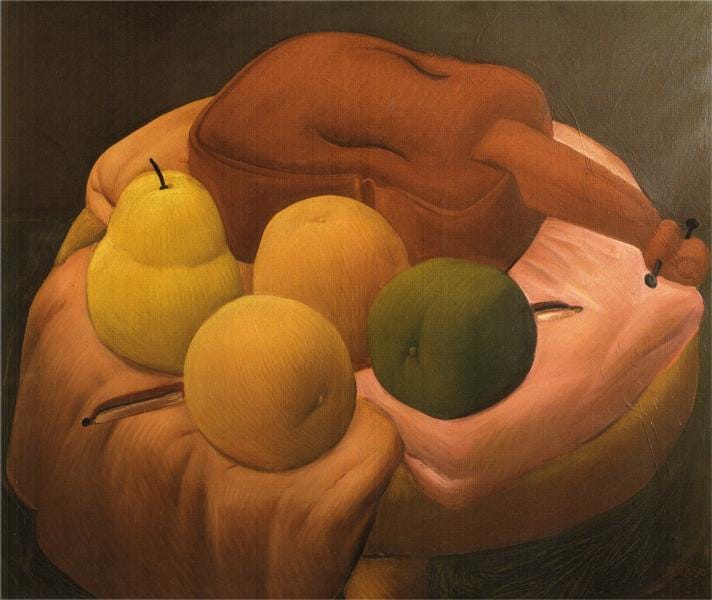
Rare Botero works are now on view in Sotheby’s new Breuer HQ. The exhibit was organized in collaboration with the late artist’s family and features 20 works, with some available for sale, ArtNet reports. “Botero in New York” is open from July 22 to September 7.
People are buying art, it seems! Sotheby’s posted a record $4.4 billion in first-half sales this year, a 58 percent YoY increase, ArtNet reports. It does seem like the Old Masters are doing particularly well; the Economist reported that young buyers, in particular, are drawn to the “stable and significantly less expensive” paintings, compared to contemporary works.
Turns out, if you charge foreigners higher prices for museum tickets, they’ll still come to the museum. That is at least true for the Louvre and the Château de Versailles, which both increased admission fees for non-European visitors in January. The Louvre alone is expected to rake in €20 million in additional income, which will help it with its much-needed renovations, Le Monde reported.
Since David Hockney’s death, there are four openings on the United Kingdom’s Order of Merit, its exclusive honor for citizens of the U.K., Canada, and Australia, who have either given “exceptionally meritorious service” in the military or “in the advancement of the arts, learning, literature and science.” There can only be 24 living members at any time; now, there are 20, The Times reports.
The Bayreuth Festival, first established by Richard Wagner, is celebrating its 150th anniversary this year, and it continues to run in the composer’s total vision: set in a theater for which he devised the specifications, featuring his operas exclusively, and overseen by his descendants. Katharina Wagner, his great-granddaughter, has been the festival’s artistic and managing director for more than a decade now, the Financial Times reports. This year, she has plans for a Ring cycle with AI projections. “This project views the ‘Ring’ as an open resonance chamber—a world to be retold again and again, not despite its history but because of it,” the program notes read. “AI becomes a mirror of collective memory—anda projection surface for the questions of our time: Who tells history? Who creates images? And whom do they belong to? Thus, the timeless essence of Richard Wagner converges with the fleeting nature of digital transformation.”
The programming also includes Rienzi, Der Fliegende Holländer, and Parsifal.
Bavaria has approved the development of a new independent panel to evaluate claims for Nazi-related art restitution, the Art Newspaper reports. Previously, such cases were reviewed by independent museums. Rüdiger Mahlo, the representative of the Jewish Claims Conference in Europe, said the move—which is expected to speed up the review of restitution claims, which tend to drag—could “set a nationwide benchmark in handling Nazi loot claims.”
I do kind of want the Lego version of Klimt’s “The Kiss,” and I am not even a Lego person. The company collaborated with Vienna’s Belvedere Museum to release the 4,000-piece set. It will be available on August 4 for $299.99. “...we had extensive discussions about Gustav Klimt’s symbolism, ornamentation, and artistic techniques, as well as how these could be represented using Lego bricks,” Belvedere curator Stephanie Auer, who worked on the project, said in a statement, ArtNews reported. “Distinctive features such as the flatness and composition were carefully translated into Lego bricks—always with the goal of staying true to the spirit of the original work.”
The next Tár? Pedro Pascal stars in Behemoth as a tortured star cellist. “Being in a gladiator arena or hanging from a harness—that stuff pales in comparison to learning how to play the cello and making it look convincing as you’re doing Tchaikovsky,” he told Vanity Fair. The movie is out December 4.
Composers to watch: Opera American has given seven female composers, including Nilhoufar Nourbakhsh, Lisa DeSpain, and Tania León, grants totaling $135,000, for the development of new work. The Emerging Black Composers Project awarded Philadelphia-based Christopher Thompson a $15k commissioning fee and other resources to workshop a symphony with the San Francisco Symphony and the San Francisco Conservatory of Music. Thompson “plans to expand on his work that explores the use of rap notation, a system used to map out rap lyrics against the musical beat, as a compositional tool,” the San Francisco Chronicle reported.
The Victoria & Albert Museum has announced its 2027 exhibitions, which include “the first major international exhibition to showcase the extraordinary breadth of creativity rooted in Bangladesh, India, Nepal, Pakistan and Sri Lanka” at V&A East, Punk to Pop and Sculpture in Clay: British Ceramics 1985 to Now at the flagship museum, as well as Chintz, which will open in September 2027. The V&A Dundee in Scotland will get a Vivienne Westwood show in March 2027, the Art Newspaper reports.
Royal Ballet star Marianela Nuñez, 44, is about to headline her own starring program at Covent Garden this summer, with six shows of “Marianela - Timeless,” described as a “celebration of the enduring artistry of acclaimed Royal Ballet ballerina Marianela Nuñez and the Company and audiences she loves.” The program includes Jerome Robbins’s “In the Night,” a bunch of divertissements, and Frederick Ashton’s “Marguerite and Armand,” which the FT describes as “a 35-minute distillation of Alexandre Dumas’s La Dame aux Camellias.”
Here’s where I will give my prediction that American Ballet Theatre will present Lady of the Camellias in its fall season, based on the evidence of my seeing a promotional photo of Chloe Misseldine in the ballet in the bottom-floor bathroom of the Metropolitan Opera House this season, when ABT hasn’t presented this ballet since 2011… ▲